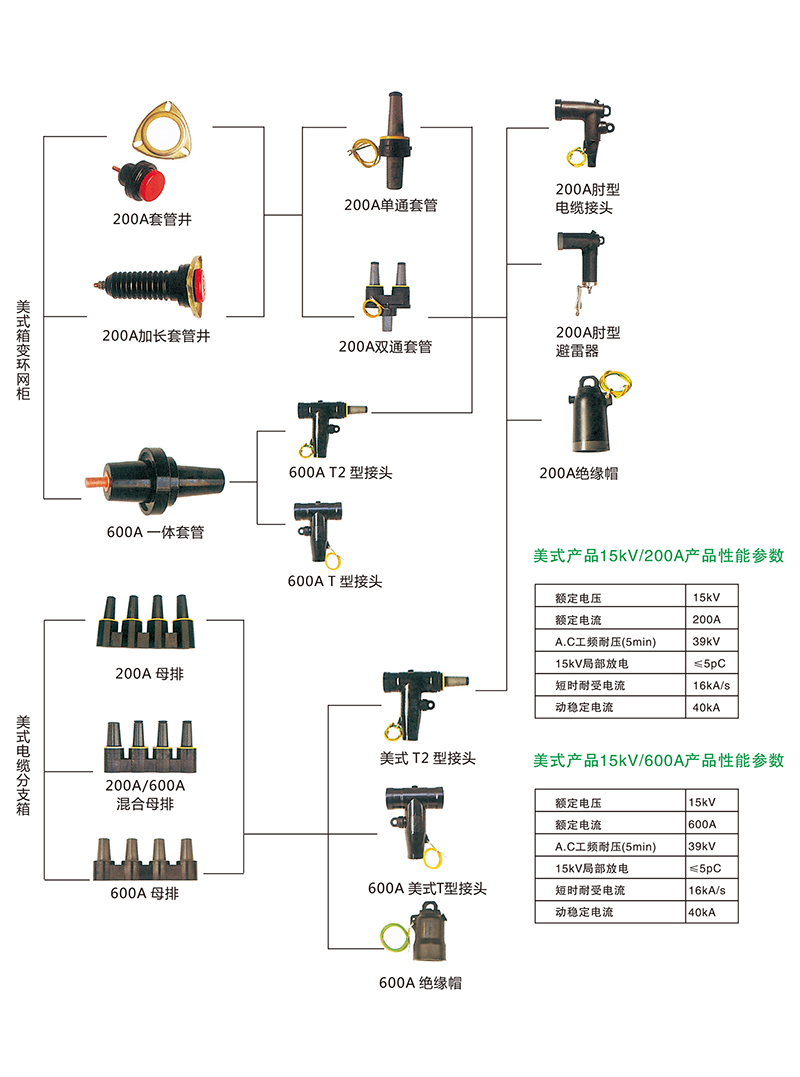


Application diagram of commonly used cable joints
Lightning arrester: An electrical appliance used to protect electrical equipment from the hazards of high transient overvoltage during lightning strikes, and to limit the freewheeling time and often the freewheeling amplitude. Lightning arresters are sometimes also called overvoltage protectors and overvoltage limiters.
Chinese name: lightning arrester
Foreign name: Arrester
Nickname: None
Applied disciplines: Information and communications
Features: High transient, overvoltage, electrical, lightning protection
Scope of application:
AC gapless metal oxide arresters are used to protect the insulation of AC power transmission and transformation equipment from lightning overvoltage and operating overvoltage damage. Suitable for overvoltage protection of transformers, transmission lines, distribution panels, switch cabinets, power metering boxes, vacuum switches, parallel compensation capacitors, rotating electrical machines and semiconductor devices.
Features and principles:
AC gapless metal oxide arresters have excellent nonlinear volt-ampere characteristics, good response characteristics, no freewheeling, large flow capacity, low residual voltage, strong overvoltage suppression ability, resistance to pollution, anti-aging, not subject to altitude restrictions, simple structure, no gaps, tight sealing, long life, etc.
Under normal system operating voltage, this arrester exhibits a high resistance state and only microampere current passes through it. Under the action of overvoltage and large current, it exhibits low resistance, thereby limiting the residual voltage at both ends of the arrester.
Classification:
There are many types of lightning arresters, including metal oxide arresters, line-type metal oxide arresters, gapless line-type metal oxide arresters, fully insulated composite jacket metal oxide arresters, and detachable arresters.
The main types of arresters include tube arresters, valve arresters and zinc oxide arresters. The main working principles of each type of lightning arrester are different, but their working essence is the same, which is to protect communication cables and communication equipment from damage.
Tubular arrester:
The tubular arrester is actually a protective gap with high arc-extinguishing capability. It consists of two gaps in series. One gap is in the atmosphere, called the outer gap. Its task is to isolate the working voltage and prevent the gas production pipe from being burned by the power frequency leakage current flowing through the tube; the other is installed in the gas pipe, called the inner gap or arc-extinguishing gap. The arc-extinguishing ability of the tubular arrester is related to the size of the power frequency freewheeling current. This is a protection gap type lightning arrester, which is mostly used for lightning protection on power supply lines.
Valve type arrester:
The valve type arrester is composed of a spark gap and a valve resistor. The valve resistor is made of special silicon carbide. Valve resistors made of silicon carbide can effectively prevent lightning and high voltage and protect equipment. When there is high lightning voltage, the spark gap is broken down, the resistance value of the valve resistor decreases, and the lightning current is introduced into the earth, which protects cables or electrical equipment from the harm of lightning current. Under normal circumstances, the spark gap will not be broken down, and the resistance value of the valve resistor is relatively high, which will not affect the normal communication of the communication line.
Zinc oxide arrester:
Zinc oxide arrester is a kind of lightning protection equipment with superior protection performance, light weight, pollution resistance and stable performance. It mainly uses the good nonlinear volt-ampere characteristics of zinc oxide to make the current flowing through the arrester at normal operating voltage extremely small (microamperes or milliamperes); when overvoltage occurs, the resistance drops sharply and discharges the energy of the overvoltage to achieve a protective effect. The difference between this kind of arrester and traditional arrester is that it has no discharge gap and uses the nonlinear characteristics of zinc oxide to play the role of discharge and breaking.
Several types of lightning arresters have been introduced above. Each type of lightning arrester has its own advantages and characteristics and needs to be used in different environments to achieve good lightning protection effects.
effect:
The lightning arrester is connected between the cable and the earth, usually in parallel with the equipment to be protected. Lightning arresters can effectively protect communication equipment. Once abnormal voltage occurs, the arrester will act to protect. When communication cables or equipment are operating at normal operating voltage, the lightning arrester will not work and is considered an open circuit to the ground. Once high voltage occurs and threatens the insulation of the protected equipment, the arrester will act immediately and direct the high voltage surge current to the earth, thereby limiting the voltage amplitude and protecting the insulation of communication cables and equipment. When the overvoltage disappears, the arrester quickly returns to its original state, allowing the communication line to operate normally.
Therefore, the main function of the arrester is to cut the amplitude of the intruding flow wave through the parallel discharge gap or nonlinear resistor, and reduce the overvoltage value of the protected equipment, thereby protecting communication lines and equipment.
Lightning arresters can be used not only to protect against high voltages generated by lightning, but also to protect against operating high voltages.
The function of a lightning arrester is to protect various electrical equipment in the power system from damage caused by lightning overvoltage, operating overvoltage, and power frequency transient overvoltage impact. The main types of arresters include protection gaps, valve-type arresters and zinc oxide arresters. The protection gap is mainly used to limit atmospheric overvoltage, and is generally used to protect power distribution systems, lines and substation incoming line sections. Valve type arresters and zinc oxide arresters are used for the protection of substations and power plants. In systems of 500KV and below, they are mainly used to limit atmospheric overvoltage. In ultra-high voltage systems, they will also be used to limit internal overvoltage or provide backup protection for internal overvoltage.